Progressive Rock Artist seeks Audience

Category: Equipment (Page 9 of 10)

Ibanez 540s


Serial# F017776

My main guitar is an Ibanez 540s. This is the original slim sculpted body version in Black Cherry, with Floyd-Rose trem. I bought it in 1988 I think. A friend of mine – a bass player no less – said that one should never let the quality of your instruments hold you back. I sold him the guitar that until then I had been playing (if I recall correctly it was one that I had basically built out of spare parts) and went shopping. It has a seriously good neck.

It still has the original F2 and C2 pickups and frankly I think they get better with age.


Working without a Fret

I’ve had a spare guitar knocking around the place for several years. It’s a Yamaha APX-10N nylon-string classical with under-saddle pickups. It’s been pretty decent but since bringing it across the Pacific, I think the climate change from muggy Auckland to dry Las Vegas has put a little out of sorts. I tried tweaking the truss rod but I couldn’t seem to bring it back to life. I haven’t been playing it much at all – it’s been hanging on the wall as a dust-gathering ornament.

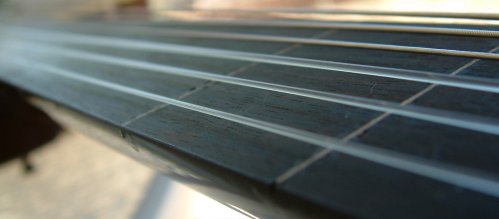
Well, the other day I took it down and pulled the frets from the fingerboard, effectively turning into a fretless guitar. I followed some online advice and used a soldering iron to heat up the individual frets prior to levering them up using a pair of flush-cutting nipper pliers. The frets came out relatively easily, with only very minor chipping of the ebony fretboard. At this point I could have just left the fret slots as-is, but being a perfectionist I wanted to try filling them with a lighter-coloured wood. Using a craft knife, I cut slivers from pine shims and wedged/tapped/forced them into the slots, welding them in place with liberal application of crazy glue.

After trimming the excess with the craft knife, I used successive sandings with 180, 240, and 320 sandpaper to eliminate the bumbs, strip off the spots of over-flowed crazy glues, and liberate a large amount of dense, dark brown wood dust. The end result is rather effective:

I’ve put a standard set of nylon strings on it, and tuned it in fourths: EADGDF. Playing it takes some getting used to. Standard barre chords are out of the question, but that really isn’t a desired function of a fretless guitar. Think slurred melodic phrases and eastern-style riffs. I’ll post some samples here in a bit – when I’ve practiced some more.

A New Microphone

Guitar Center -the Wal-Mart of musical instruments – are having a “green tag” sale this month. Normally I ignore their advertising bumf that appears in our mailbox. Their “deals” are never quite as good as they make out. Online stores will offer a better selection and better prices. This is sad for the local stores. (On the other hand, if there was a local store run by people I respect and wanted to support, I’d go there. But I haven’t found one yet. It probably doesn’t exist.)

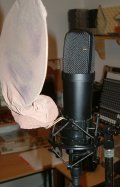
OK, so the point is, I *did* browse the flyer and saw a bunch of things I was interested in. After actually visiting the premises, I escaped having merely purchased a new microphone. It’s a MXL 2001 condenser, requiring 48v phantom power but that’s ok, I have that on the Mackie 1604 mixer.

Initial tests are good. It’s very sensitive, in fact it picks up the drone of the fan in the computer. *sigh*. Hopefully I can use it for vocals and percussion and stuff, without resorting to isolation boxes or sound-proofed closets. The picture shows the mic with the standard “coathanger+nylons” pop filter.

Roland SPD-20 Pad Controller

Serial# CR39670

My right arm totally lacks co-ordination and power. I am left-handed; so this is not completely unexpected. Also, since my accident many years ago my right shoulder has been a bit iffy.

However, I was not prepared for a complete inability to beat a drum rhythm in time!

This revelation is a result of a new acquisition in the studio equipment arena: an electronic drum trigger unit that you can beat with sticks! It’s a simple, 8-pad thing that you can set up to drive all those other keyboardy, rack thingys via MIDI signals, with a few good built-in sounds as well. I got it because, well, I’m stuck on a couple of music projects and I wanted to try something different to kick-start some creative action. They both need better rhythm tracks, so this seemed like a good and challenging idea.

I never expected to be the world’s greatest drummer – except in my mind, of course – but merely beating out a regular kick-snare combination seems to be beyond me, unless I just use one stick in my left hand, and let it do all the work. Depressing. This will need practice.

Other than my human limitations, the pad itself seems pretty good. Drum techniques like flams, rolls, fills, and other stick tricks seem easy to do on the rubbery rectangles. Bok Factor 8.

My first attempts to use it to lay down grooves failed to best my existing “keyboard drumming”, and shortly afterwards I gave up.

Two or three years later, I give it another go, this time augmenting the unit with a bass drum trigger and foot pedal, and a high-hat control pedal. I ran into difficulties, both in co-ordination (it would help if I had any real practice playing actual drums) and also in configuring the MIDI mapping between the physical pads and the layout of XLN Addictive Drums across the note grid. High-hat control in particular had a kind of impedance mismatch between controller data and MIDI note numbers.

So I gave up again.

Recently I’ve broken out the pads again, at first just to fix up some tom and snare rolls. For some reason, this time I’ve found a process that works better than the keyboard, for all drum parts. I’m not using the foot pedals, and I have to record the complete drum part in several passes using pad mappings to different subsets of the kit, but the net result is quite satisfying. 

There are still mistakes and bad groove choices, but I always had those problems with the keyboard anyway. 

« Older posts Newer posts »

© 2026 The Prodigal Sounds

Theme by Anders NorenUp ↑