Progressive Rock Artist seeks Audience

Author: colin (Page 38 of 39)

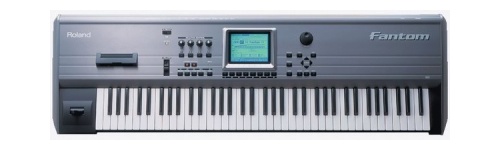
Roland Fantom FA76


Serial# ZPO1825

I like the fact that this has 76-keys, but is still “synth action”. It has a really good keyboard feel, reminiscent of the D-50. The sounds aren’t bad either. A bit too techno for me but there are some nice patches.

Here’s the story of how I got it:

In the paper today: an ad for “Mars Music Closing Down Blowout Sale”.

Mars is a pretty big nationwide chain of musical instrument stores, and recently they filed for Chapter 11 or whatever the legal state of financial restructuring is. It seems that this didn’t work out, and the stores are now starting to have liquidation sales across the country. The music newsgroups I frequent have been talking about them as various stores in various towns close up shop. Some have had so-so deals, others have massive 50% discount on everything. I guess it’s the turn of the one in Las Vegas.

*

When I moved to the States I reduced my music keyboard arsenal to just one: my trusty Korg M1. It’s more than 10 years old now, still a source of interesting sounds and the “master” device through which I perform the keyboard parts, even if it no longer forms the nexus of my studio. It still seems to be reliable but I’ve been anticipating its failure from old age for about a year or so now, and I’ve been scanning catalogs and music store displays for possible replacement candidates, in order to be prepared for how much it would cost to replace the M1 with a comparable keyboard.

One possibility was the “Fantom” by Roland. I liked it because it has 76 keys (the M1 has 61) and I could use the extra octave, and also the keyboard had a good feel. Often similar products with that many keys also offer “weighted piano action” which is nice for classically trained musicians used to real pianos, but not so good for me. The Fantom has “synth action” which means it’s nice and bouncy and good for trilling lead passages.

In my occasional price surveys I’ve seen it usually going for $200 below list price in typical music stores. Mail order catalogs said $300 below list for a while, the last one I got said “price too low to print! Call for price” although it’s not like Roland have announced a newer model or anything. On E-Bay I’ve seen it offered for $450 below list, but I wouldn’t go there unless I was desperate. (Call me an e-bay virgin, I don’t mind.)

I haven’t been planning on a purchase unless the M1 failed. If it did, I would be prepared to go out and pick up a Fantom without thinking, secure in the knowledge that I’d done my homework and it was exactly what I wanted, and that the expense is budgeted for and justified.

So back to today… seeing the Mars Music “closing down” sale advertised in the paper made me think that I should at least check it out. Even though the M1 isn’t failing (yet), I’d kick myself if I didn’t at least see if they had any Fantoms on sale.

I took a few hours out of the work day to check out the sale and drove off into town.

There were a *lot* of cars parked outside Mars Music.

As I walked in to the store, it was chaos. I couldn’t see many sales people around, but there were piles of boxes, purple cards with “reduced price” stickers, red cards with “take an extra 20% off marked price”… I walked around a rack of bongo drums and dodged an aisle of audio mixers, and headed for the keyboard section. Piles of acoustic foam ripped off the walls were scattered around.

“Ok, focus,” I told myself. “Don’t get distracted. If they have a Fantom, and it’s, oh, say, $600 below list, then get it. Otherwise, don’t be seduced by all the “great deals” because you don’t really need them, even though they look like complete bargains…”

They had one Fantom left. The overlapping price tickets indicated it was marked down $400, no, $600, no, $800 below list.

It was the display model, but given that the keyboard worked across it’s full range and I could navigate its LCD screen, there was nothing an application of a dilute solvent wouldn’t clean up. (Some grubby finger marks!)

So I picked it up, took it to the register, and looked keen until I could find a sales person. You had to grab them when you found them, they were rare and looked very flustered and busy. It turned out that the latest marked price *still* didn’t have the final discount applied to it. Yeah, it was a steal, basically half price.

No case or box or anything, but they did manage to dig up most of the manuals for me.

It *just* fit into the trunk of the car. 76 keys makes for a wide keyboard!
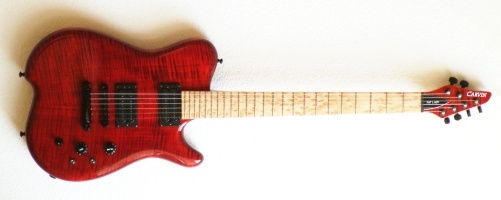
Carvin HF2 “Fat Lady”


Serial# 74700

The “Fat Lady” is a wonderful product of the Carvin factory in San Diego. She’s a Holdsworth “fatboy” model, which means a hollow body – you can tap it and hear a hollow “bok” sound.

You get to specify your options when you order from Carvin, and I had a very clear idea in mind for this guitar:

  • Flamed maple 1/8″ top
  • Ruby stain, gloss finish
  • matched headstock
  • Birdseye maple fretboard
  • No inlays on fretboard, side dots only
  • Clear satin finish on neck
  • Black chrome hardware
  • 2 coil taps
  • Engraved truss rod cover: “Fat Lady”

Even though I’d specified gloss on the body and clear satin finish on the neck, they managed to do it. I relocated the strap post from the back of the neck joint to the top “horn”. I think it hangs better this way. Others disagree.

Hear the fat lady sing:

This little multitracked demo shows off some of the sounds I can get from this guitar, using the Line6 POD 2.0 and Digitech GSP21 effect units. The timing is a little wonky in places.

Here’s another piece featuring the Fat Lady: Greener Pastures:

This solo composition is going for the warm jazz tone but the HF2 doesn’t quite want to go there. I’m perfectly happy to go where it wants to, however.

Update: In recent years I installed a Graphtec GHOST piezo bridge in this guitar. Details available on the Carvin Forum: Haunting the Fat Lady.

Mixers

After 8 years of faithful service, it looks as though my audio mixer is dying. I thought the crackling and channel droppouts were caused by a computer audio card problem, but after some comprehensive detective work (duh – it happens even when the computer isn’t switched on) I discovered that the mixer itself was the culprit.

Because the problem is on the playback channels only, this is both good and bad: 1) it doesn’t affect the recorded sound, and 2) I can’t re-patch and avoid experiencing the problem.

I’m currently researching features and costs of a replacement mixer. This one is a possibility.

Audio Hard Drive Hell

Maestro, my music PC, was acting up. It would stop recording, stutter, or just plain fail to perform its function of being a digital audio workstation. I finally did what I should have done a while back: benchmarked exactly how many stereo 24-bit audio tracks it could handle before suffering from “dropouts” which is when the software halts because it is too busy to keep up with the audio flow.

The answer was 8.

I thought this sounded a little low, so I did some research on other users of the software to see what was acceptable to them. They were pretty shy about it, citing things like “well, it depends on your hardware, etc etc” (even the KEYBOARD magazine review of the software wouldn’t say), but eventually I found a review online that came out and said 72.

72!!!

OK, so maybe they were mono tracks. So, in stereo that’d be… 31.

I got 8.

The online review went on to say that with tweaking, he could get 110. (I’m sure they were mono tracks.)

Aaughhh! As Charlie Brown would say.

After much audio parameter tweaking and changing cluster sizes and posting on the newsgroup for advice, I was still unable to record a 9th track without the “disk activity” meter pegging at 95% followed by a dropout.

Clearly, the wonderful choice of a Ultra-Wide SCSI-only disk subsystem for Maestro when I specified it two years ago just wasn’t cutting it any more (I don’t think the data throughput rate went *down* exactly, it just wasn’t the right choice for audio applications.

After some consideration of budget, size and speed, and desirable goals of having at least two useable PC’s at the end of the day, we ordered (1) ATA/100 60GB Hard disk and (1) ATA/100 controller card. (ATA-100 is a fast but different kind of hard disk interface from SCSI.)

Last night I dismantled Derek’s old PC (we dubbed it “Athena”) and Maestro, threw all the hard drives into the air and held out a PC chassis in each hand, catching the drives as they fell. (ok, not really!)

End result: Athena has the SCSI system, with the two hard drives, CDR, and CDRW originally from Maestro. As primary boot disk she has the 15GB IDE drive. The case is pretty full, but it seems to be working.

Maestro has the motherboard IDE controller disabled, as before, but now has the ATA/100 controller card in a PCI slot. He’s running the 6GB drive from Derek’s old PC as a boot device (operating system and other audio software) along with the CDROM on one IDE channel, and the new ATA/100 disk on the other channel, as a dedicated audio storage drive and back up drive. 

End result? After reinstalling all the drivers, software, etc, and loading up my test project, I got it playing back 20 stereo tracks, with the disk activity meter hovering pretty steady around 38%. Say 40%. I didn’t continue, but I conservatively estimate 40 stereo tracks would be a safe top end for this configuration. That’s much more in the ballpark.

So, happy happy. Studio work continues.

The Music Heats Up

The other day I was creating a CD on Maestro, my music studio computer, when I noticed hot air being exuded from the open CD drive. I reached down to feel the side of the PC. It was hot! Very hot! I took the side panel off and took a closer look. The power supply fan had seized up, and the power supply looked like it might melt at any time – I could not rest my fingers on it, in fact it was spit-sizzling hot if you want a graphic description. I quickly shut down the open applications and turned off the computer. I was suprised it was still running ok, but I guess the processor fan was still ok, so it didn’t malfunction.

Anyway, that afternoon I made some phone calls to see if any place local had a 250W ATX power supply, and none did. I knew the place that would have it: PC Club on Sahara, or failing that, next door at CompUSA, a larger store in a popular chain.

At 4:30 I jumped in the car and drove 20 minutes down the freeway and walked in to PC Club.

Here’s an aside: It must have been about 7 years ago that I made a trip from NZ to the States to visit Lisa, and we drove to Vegas to visit her Dad, and of course Stan had computer problems – probably a RAM upgrade – and he took us to PC Club which is where he got the machine from, or something like that. Anyway – my point is a) it’s cool that a small hobbyist kind of place is still in business 7 years later, and b) never in a million years would I have imagined going there for my own PC needs. But I digress.

PC Club had lots of Power Supply Units (PSUs) sitting on a shelf, so I grabbed one, opened the box and checked that it was the right size, and bought it.

It was about 6:15 when I got home again. Traffic was a little stinky given the hour of the day… but I figured I had an hour before I wanted to start cooking (Farscape was on the SciFi channel at 8:00 and we’ve kind of got into the habit of watching it with dinner), so I lugged Maestro onto the kitchen table and disconnected the power supply, putting on the table next to the new one.

That’s when I noticed that I had bought an AT-style power supply instead of an ATX one. (Basically, the connections to the motherboard are all different). Argh!

After some meditating, I decided to drive back out and see if I could swap the PSU for a more suitable one. I really didn’t feel like driving back down the valley, but on the other hand, I wanted to get this out of the way – I didn’t like the thought of Maestro being out of commission.

Traffic was lighter heading South on ’95, and I took a slightly different route, having figured out on the last trip that there was an easier way to go. I walked in to PC Club and the clerks laughed at me as I held up Maestro’s PSU saying “I made a mistake. I need one of these instead!” (This is a really newbie mistake, I was really annoyed at myself for getting confused.)

“Well, let’s see,” said John the sales clerk. “It looks like we don’t have any 250W ATX PSUs,” he observed, checking the shelves. “We do have these 350W ones, but they look like they’ll be too big. We’ll have some new ones delivered tomorrow, I think, do you want to call in and see?”

“Ah, well, I guess I could call,” I replied, grumbling. I really didn’t want to waste the second drive down and then drive down yet *again* the following day. I got a card with contact details and took my dead PSU and the new (wrong) one back the car and resigned myself to the inevitable.

It’s a stupid driveway – you have to exit on to Sahara the wrong way, then do a U-turn to head back to Valley View in order to get back on the ’95 Northbound freeway. After making the U turn (waiting for a gap *forever*, the traffic having gotten worse for some reason) and heading back to the intersection I see the red neon of CompUSA (which was next door to PC Club).

“Hang on,” I thought. “They might have the right PSU. I should check them out.” So I did *another* U-turn and headed back East on Sahara, pulling into the CompUSA parking lot.

I was still holding the dead PSU, dangling by its connector cables. They put a sticker on it at the door so that no-one would think I was stealing dead power supplies from CompUSA.

CompUSA did not have any 250W ATX power supplies. They did have two: a 400W and a 500W respectively. In frustration I opened one of the boxes to observe that they were the same size as the dead 250W one.

I discovered that CompUSA have display cases which are just the right height for beating one’s forehead against.

I walked back to PC Club, still clutching Maestro’s dead PSU. The sales clerks laughed a second time.

“OK, I’ve just seen 400W and 500W PSUs in CompUSA that are the same size as this one. Can we open one of the boxes of your 350W units to see if they are actually the same size?”

We did, and it was, and I made the exchange. OK, a bit more expensive than I’d thought, but it couldn’t hurt to have a good quality and more capable power supply in Maestro anyway.

Once again, I drove out the wrong way, waited for a gap, made the U-turn, and headed for home.

Maestro is running nice and cool now.

RAM

Computer RAM prices were at the lowest they’ve been for a while, so I decided to order some DIMMs and max out all the machines we own. Maestro, my music studio computer now takes 2 minutes to go through it’s power on memory check, and I have to do a double take when I see it’s got 640kB – wait, that’s 640 MB – of RAM. Not to boast or anything. But I have on occasion processed an entire CD’s worth of audio (cross-fades, E.Q., that kind of thing) and it is fun to load the whole thing into RAM and get the performance boost from not having to page on and off hard disk. So it’s utility, not frivolous <g>.

« Older posts Newer posts »

© 2026 The Prodigal Sounds

Theme by Anders NorenUp ↑