Progressive Rock Artist seeks Audience

Author: colin (Page 30 of 39)

Mic vs. Piezo, Virtual Tonewheel vs. Rompler

Here’s the pattern: It all starts when someone (Tony!) asks for a CD of my music. So I start compiling the tracks that I want to include, and I hear something in one of the pieces that was supposed to be finished and completed, and think, “I’ll just open up the project in SONAR and tidy up that glitch.” Well, the first thing that happens is that the project is from SONAR 2.0 and I have to migrate it to SONAR 5. No biggy… but there are a few features in SONAR 5 that really make things easier – like track folders and effect bussing and improved effect plug-ins.

Then I realize how much I like actually playing this music instead of just listening to it. So I break out one of my guitars – these days usually the Carvin HF2 – and mute an instrument in the Track View, and play along. Then I make a mistake, or play something different for a change, and suddenly I really want to re-record the entire track. Because I can play it better now. Or this newer instrument sounds better. Or the timing was off a little, before. Or I have a better microphone now.

Which leads me to my current project, a piece called “Strange But True”. The excuse for firing up the studio on this one was that SONAR 5 included a plug in called “V-Vocal” which provides sophisticated pitch correction for monophonic audio sources – such as vocal tracks. I can usually sing in tune but being a perfectionist, I am never completely happy with the results. I think of V-Vocal as spackle – applied judiciously it is pretty seamless and improves an acceptable performance to one where it can sound like the vocalist was just “on” during the session. I like it.

If only I could stop there. But no… As I listened to the mix, it seemed to me that the Ovation steel string guitar was out of time in places. So I break out the Ovation and put some new strings on it, tune up, and start to play along.

Then I have an idea – instead of just tracking the built-in piezo acoustic pickup in the guitar, why don’t I simultaneously record the natural acoustic sound using my new MXR condenser microphone? (Yowser… I say “new” but I see I got it more than a year ago…). Seemed like a good idea.

Oh boy. I didn’t know what I was missing. Or to put it another way, I did know but I didn’t care. Well, now I care. The acoustic sound is way better than the internal pickup. It has “more wood” in it. Also more finger noise, but hey, that’s part of the performance.

Several weeks pass as I regrow callouses on my fingers, and practice playing the notes cleanly.

To cut a long story short, starting with the much improved acoustic tone, I’ve re-recorded all the guitar parts. I’ve also replaced all the synthesizer parts with sounds from my Roland VK-8 virtual tone-wheel organ, because it sounds so good. Much less artificial and, well, electronic. It’s not a real Hammond organ but it’s as close as I’m ever going to get. I didn’t realize how suited it was to this particular piece of music, but once I started playing around and trying things out, it was a no-brainer.

Now I’m working on re-doing the drums and percussion. Real tamborine, real shaker, real doumbek.

I know this doesn’t get me any closer to finishing the other various songs and bits of music I have in my head, but this is too much fun. The final result is going to be awesome. And this time, it’ll really be finished. No, I mean it.

Why are you looking at me like that?
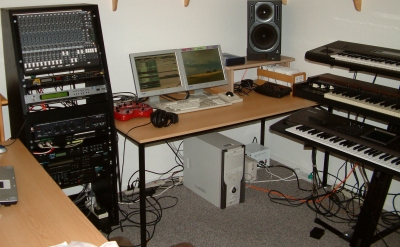
My New Workspace

A change can work wonders with the creativity. I’ve been a bit stuck since Karma died, so to cheer myself up I got a new keyboard stand and a new equipment rack. Here’s a picture of the new layout:

The rack kit was from RAXXESS; the synth stand is from Ultimate Support. Amazingly I found enough cables to keep things connected without having to purchase any new ones. It was a close thing, though.

V-Vocal on a Bass Line

I “finished” working on a version of my song “Listen” a month or so ago, but I was listening to it again today and I realized that, when I’d changed the final reprise of the chorus from a minor to a major key, I’d left a flattened 6th note in the bass line unchanged. Probably no-one except me would notice, but I thought it stuck out like, well, a flattened 6th in a major scale.

I opened the project in Cakewalk‘s SONAR 5 (My Digital Audio Workstation software of choice), made a copy of the bass track, and applied the V-Vocal plugin to the relevant section. V-Vocal is part of the SONAR 5 Professional bundle and is normally thought of as a Vocal pitch and formant corrector (to “fix” a terrible performance. Use with caution, apply conservatively, and not that *I* need to use it on *my* vocals… yeah, right), but it works very well on any monophonic audio. It did a great job of sharpening up that 6th note in two places. Thanks, Cakewalk! I did not want to try and “punch-in record” that bass line. For a start, I’m not sure what outboard processing I used on the Chapman Stick when I recorded it in the first place, many years ago.

Nut Replacement Surgery

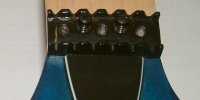
The Blueshifter was perfect in every way except for one. The open high E string would drone like a sitar. I determined that this was due to the locking nut: Either the angle was wrong, or the slot mis-shaped, or a combination.

The problem was still apparent after switching from 9’s to 10’s, and I started thinking about purchasing a replacement locking nut. But then I got to thinking: The Blueshifter is fitted out with sperzel locking tuners – string pegs that actually clamp on to the string.  Even though guitars with Floyd Rose trems usually come standard with locking nuts for tuning stability, is the locking nut really necessary?

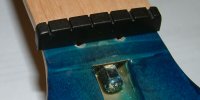
Several people on the Carvin Guitar BBS have said that it is not: A decent, regular low-friction graphite nut should be just fine if the guitar has sperzels. Seeing as I was planning on replacing the nut anyway, I figured I had nothing to lose by giving it a try. A few clicks and four bucks later and the Carvin online web store was shipping me a regular graphite nut. And yesterday it arrived in the mail.

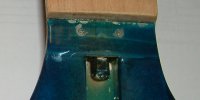
Removing the current locking nut was easy. It’s attached to the neck by a couple of screws. After I removed the nut I realised several things that should have been obvious: Firstly, the truss rod access cover plate is somewhat shorter for guitars fitted with locking nuts; Secondly, the locking nut sits on a flat area of the headstock parallel to the neck, while the rest of the headstock tilts back at the usual angle; and finally, the new graphite nut was a “blank” in that it was generously sized and would need to be filed and sanded into optimum shape for the guitar.

And hence begins a tale of mistakes that I am reticent to relate. Let’s just say that for a while I wish I’d ordered two nuts!

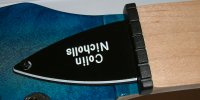
I used 230 grit sandpaper to put a slight angle on the nut – then realised it was going to slope the wrong way – then corrected it – then wondered if it was now too short to adequately lift the strings away from the frets. Then I had the bright idea of using superglue to fasten the nut in place. Oy. I must have been crazy. I actually realised the risk and problems associated with this decision yet somehow my arms and hands didn’t get the signal and plopped the nut perfectly into place – which promptly slipped sideways and stuck! Talk about locking nuts. At the very last possible instant my brain got its act together and I flicked the nut off the neck with my thumbs. The traces of glue on the nut were easily removed with some careful additional sanding.

I used a couple of blobs of PVA to secure the re-finished nut in place. I might want to remove it later on, and the strings themselves will hold the nut against the neck. I had a spare regular-sized truss rod cover to use, and although the remaining exposed flat region where the locking nut was located is still detectible, it doesn’t bother me.

So far, it seems to be a success. As far as I can tell with this new set of strings, the tuning is quite stable, even after fairly agressive tremelo action.

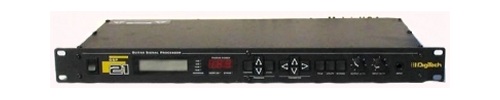
Digitech GSP21 FX Processor

Serial# 288889

Ah, my trusty multi-effects unit. I can’t remember where or when I purchased this but it was my main guitar FX for years until I realized what the tube amp aficionados were on about. This has mediocre distortion and compression when compared to what’s available these days, but in my opinion the delay and reverb algorithms are outstanding. I now run the FX loop out to my POD for compression and amplifier modelling duties.

I have the floor-board for this, but I don’t use it since I accidentally unplugged it while the power was on and it reset the patch memory. Disaster.

Update November 2020: This unit has been refurbished and passed on to a new owner. Details here.

Line6 POD 2.0


Amplifier modelling is the best thing to happen to recording guitarists since the invention of the Floyd locking nut. In my opinion.

I have been unable to get a decent bass patch out of this thing, though. I know it’s theoretically possible (albeit it is a guitar effect unit) and there are instructions on the Line 6 web site. I should try following them sometime.

This is one of the few pieces of equipment that made me scrap my existing recordings and rework them, this time with the lead and rhythm guitar using the POD. I didn’t know what I’d been missing.


« Older posts Newer posts »

© 2026 The Prodigal Sounds

Theme by Anders NorenUp ↑